Showing posts with label community impact. Show all posts

Friday, November 4, 2016

Salute! to the Center for Disparity Solutions and Equity

DETROIT, MI - The Center for Disparity Solutions and Equity (CDSE) - a community-driven organization by the University of Michigan-Dearborn, College of Education, Health, and Human Services, received the Breakthrough Award from the Greater Detroit Area Health Council (GDAHC) during its annual awards dinner Salute! to Healthcare on November 3, 2016 at the Atheneum Suite Hotel in Detroit.

CDSE received the 2016
Breakthrough Award
The Breakthrough Award is presented to an individual or organization for their impact on the health and well-being of southeast Michigan through community engagement and innovation. This year GDAHC decided to honor the Center for Disparity Solutions and Equity (CDSE) with this award.

The overarching objective of the CDSE is to develop evidence-based solutions that seek to create equity across education, public and community health, healthcare, wellness and human services. To achieve this aim, the CDSE partners with community, corporate, education, government, health and wellness organizations spanning the Detroit area, the State of Michigan and the United States.

Working in collaboration with these stakeholders and through the application of leading-edge research, the CDSE seeks to implement actionable solutions by way of innovative programs and policies, systems and environment best practices and responsible evaluation mechanisms—among other channels.

Center of Disparity Solutions and Equity team members
  Currently, there are more than 20 professionals, from the University of Michigan-Dearborn as well as a number of regional organizations and institutions, associated with the CDSE. These regional organizations range from healthcare payers to free clinics to health systems to school districts to social service organizations and more.

Examples of the substantial work, with actions implemented, that have been completed include:
  1. hotspotting to identify geographic areas of high concentration of chronic diseases and at-risk populations
  2. across-sector collaborations to lessen the disparities and burden of determinants of health;
  3. working of institutional policies to increase equity; and
  4. convergence of education and health and human services entities to increase educational attainment and quality of life. Some of the areas of clinical focus has involved, but has not been limited to: autism spectrum disorder, diabetes, hypertension, asthma, bipolar disorder, and learning disabilities.
The CDSE features knowledgeable faculty and staff members who are passionate about eliminating disparities across education, health and human services. These experts bring together other faculty members, students and communities in effort to help eliminate disparities.

The CDSE works from the position that progress and positive change can be realized, that equity throughout the areas of education, public and community health, healthcare, wellness and human services is a true possibility.

Friday, October 28, 2016

CEHHS Education Student Applies Knowledge to Help Children in Haiti

Rachel and Valmy. Valmy was the first child
sponsored through Reach Out
Rachel Marple, visited Haiti, for the first time, six years ago on a mission trip with an organization called Reach Out to visit remote villages located in the mountains to install water filtration systems. During this trip she remembers having met a young man with Down syndrome whose family was unaware that his condition even existed. “It was then and there that I decided to pursue a degree in which I could take overseas what I was learning here at home”, Rachel said.

Now, she is currently earning her Bachelor’s Degree in Special Education: Learning Disabilities at UM-Dearborn College of Education, Health, and Human Services (CEHHS) and she is also the co-founder of the non-profit organization “Reach Out: LaFond”.

LaFond is a community located 40 miles from Port-au-Prince that struggles with impoverished conditions and children do not have access to quality schooling. “Reach Out:LaFond” was created to inspire people to sponsor the education of students. In Haiti, many students are required to live without their parents in order to go to school in faraway places, so the mission of this organization is to provide a better education to children within their own community.
 
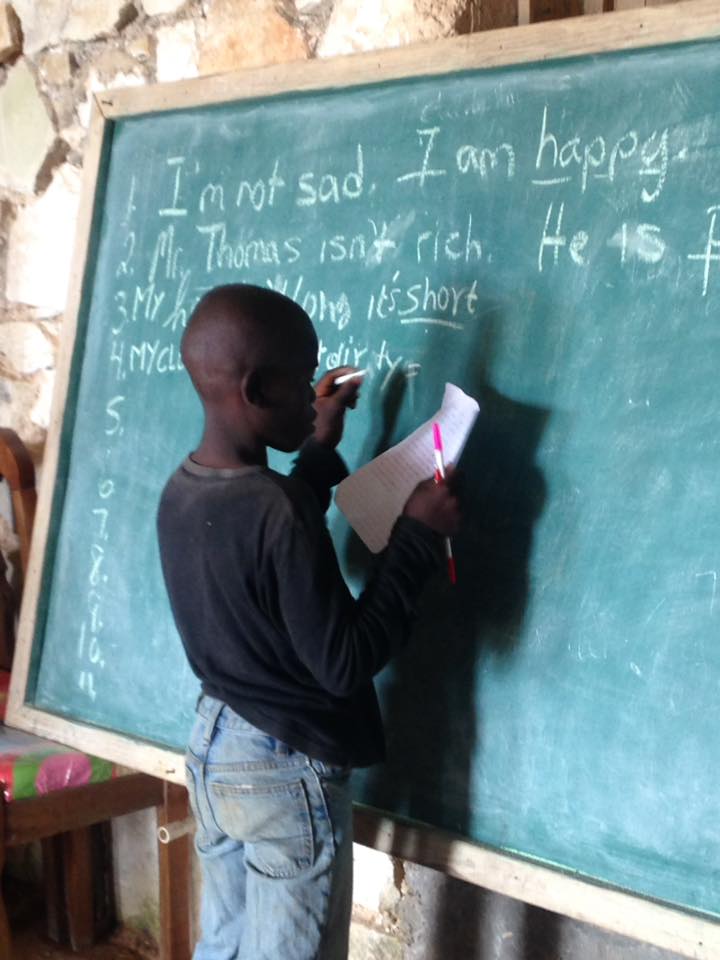
Djerson, a student in LaFond, practices
writing sentences in English


In addition to be the co-founder of “Reach Out:LaFond”, Rachel serves as the Treasurer and Mission Trip Leader. Currently there are three members who maintain the organization and they are in the process of adding two new board members to the team. The organization has approximately 50 families sponsoring over 65 children in LaFond.

Rachel is very active working on finding sponsors and planning the trips. Currently the organization is fundraising for the construction of a new church; they partnered with another organization to bring shoes to students; they recently started a lunch program in which students receive a hot meal during the school day and this past summer they had their first medical mission trip.
“We were able to see and treat 688 patients throughout the 4-day clinic”, Rachel said.

Volunteer nurses seeing a young patient during the medical mission
trip

Rachel mentioned that the Special Education: Learning Disabilities program is providing her tools to share with the teachers of the school in LaFond. For example, they are working with staff to implement an RTI program (Response to Intervention) within the schools that will help identify at risk students before waiting for them to fail. Rachel reflects on her education, “I truly believe that as a result of my education, Reach Out will produce more effective teachers and in return have children who are flourishing academically.”

Looking to the future, Rachel would like to work with the school administration in order to implement a PBIS program (Positive Behavioral Interventions and Supports). The organization also set a goal to help schools add on a grade each year until hitting the 12th grade. Right now, schools go from Pre-K to 7th grade.

“We want to see our students grow up to be world changers, and I believe they will be as long as they have access to education. After all, people only know what they are taught!”, Rachel said.
Elementary students pose for a photo during recess
To learn more about ReachOut:LaFond, visit their webpage at http://www.reachoutlafond.org

Tuesday, July 26, 2016

Center for Disparity Solutions and Equity (CDSE) partners with Samaritan Center


As a part of its mission to eliminate disparities and promote equity in education and health, the College of Education, Health, and Human Services (CEHHS), through its Center for Disparity Solutions and Equity (CDSE), recently partnered with Samaritan Center.

Located in East Detroit, Samaritan Center is a one-stop resource location that serves more than 1,500 southeastern Michigan residents daily and houses more than 80 community services.

Through the partnership, CDSE evaluated Samaritan Center services with hopes of expanding the service menu, improving their community outreach and highlighting the center as a model for other communities.

“Twenty percent of the people went to four or more partner organizations. That tells you they are meeting their mission of being a one-stop resource,” said Center for Disparity Solutions and Equity Program Manager Jennifer Teller, who conducted the work with CEHHS Dean Janine Janosky, Associate Dean Laura Reynolds and Public Ally Amanda Ford. “And visitors had thoughtful ideas of what else they’d like to see at the Center and were happy to share them. For example, one young man said the Samaritan Center is a safe place in a challenged neighborhood and suggested a park for children.”

Earlier this month, the team presented their findings to the Samaritan Center. Teller said the partnership was a success and the CDSE will continue to seek out and work with community organizations.

 
Jennifer Teller, program manager in CEHHS and
Br. Francis Boylan, CSC pose with children at the
Samaritan Center (Photo by Kathleen Malicke)
“It was satisfying to see that the Samaritan Center visitors and partners were all on the same page. They were appreciative of our work,” she said. “Research is an important endeavor as many people are out there helping others in need. We worked hard to assist them in fulfilling their mission by determining the impact of the Samaritan Center.”

Samaritan Center Executive Director Mark Owens said, “Samarian Center has been fortunate to find a partner with University of Michigan-Dearborn’s College of Education, Health, and Human Services to work with us to better serve the thousands of Detroit residents who visit Samaritan Center and 87 partner agencies. The professionalism, the attention to detail and responses to our questions have been excellent and we look forward to a long-term relationship.”

About the Center for Disparity Solutions and Equity
The College of Education, Health, and Human Services (CEHHS) formed the Center for Disparity Solutions and Equity in 2015 in order to continue CEHHS’ emphasis on scholarship, diverse health and human services experiences, and effective instructional and leadership practice. The Center for Disparity Solutions and Equity aims to reduce disparities for a movement to equity in education, health, and human services focused upon policies, systems, and environments. To learn more about the Center visit umdearborn.edu/cehhs/cehhs_cdse.

Tuesday, July 19, 2016

UM-Dearborn partners with five Michigan universities to improve the health of children with disabilities


The University of Michigan-Dearborn is one of six Michigan universities partnered on a $2.2 million, five-year grant from the Maternal and Child Health Bureau of the Health Resources and Services Administration for the project “Leadership Education in Neurodevelopmental and Other Related Disabilities (LEND) Maternal Child Health (MCH) Training Program,” or MI-LEND. The purpose of MI-LEND is to improve the health of infants, children, and adolescents with disabilities in Michigan by training individuals from diverse disciplines to assume leadership roles in their respective fields and work across disciplines.

MI-LEND is a consortium of six universities including University of Michigan-Dearborn, University of Michigan, Wayne State University, Michigan State University, Western Michigan University and Central Michigan University; all six universities will contribute faculty and trainees. The Developmental Disabilities Institute (DDI) at Wayne State leads the consortium with Sharon Milberger, Ph.D., director of DDI, serving as the MI-LEND program director. Jane Turner, M.D., pediatrician and professor at Michigan State University, is co-director.

 
Dean Janine Janosky
The lead at University of Michigan-Dearborn is Janine Janosky, PhD, Dean of the College of Education, Health, and Human Services. “We at the College of Education, Health, and Human Services  at UM-Deaborn are excited to collaborate with our 5 Michigan state universities in this consortium.”, said Dean Janosky. “Through the consortium, we are working together to expand graduate-level training for working in the fields of neurodevelopment disabilities and autism.  The graduates of our programs will positively impact the children they are serving as well as work to improve the systems of care for children with neurodevelopmental disabilities and autism."


MI-LEND leaders will work in collaboration with members of Michigan’s Title V program, including Children’s Special Health Care Services, the governor’s Autism Council, the Michigan Chapter of the American Academy of Pediatrics and other key statewide disability/advocacy organizations.

MI-LEND will address the complex needs of those with autism and other disabilities, such as cerebral palsy, by increasing the number of graduate, doctoral and postdoctoral students prepared to address their needs. In addition, it will increase the number of providers available to diagnose and treat infants, children, and adolescents with disabilities. An important component of MI-LEND is participation of family members and individuals with neurodevelopmental disabilities in developing the curriculum and working with trainees to ensure a family-centered approach to care at all levels.

“Expanding the educational opportunities related to the treatment of autism and other developmental disabilities for over 181,800 medical and professional students and physicians will help improve the quality of care for these individuals and increase their ability to have self-determined independent lives,” said Lt. Gov. Brian Calley. “I am proud to see Michigan’s universities working together on advancements in this area.”

To learn more about the MI-LEND program, contact dean Janine Janosky at jjanosky@umich.edu

Thursday, June 23, 2016

Four external grants awarded to CEHHS Faculty

The College of Education, Health, and Human Services is pleased to report that faculty received four external grants. These competitive funding opportunities enhance the College’s mission of strong academics, innovative research, and engaged learning through a metropolitan vision for providing new knowledge and developing leaders in Southeastern Michigan.

The following four projects received funding from external grants:

Leadership Development Program
to Janine Janosky
by Molina Healthcare of Michigan
Description: She received a contract from Molina Healthcare to develop a customized high-quality leadership development training program for Molina employees to aid with ensuring a competitive edge for the healthcare provider.

Improving Teacher Quality
to Karen Thomas-Brown and LaShorage Shaffer
by Michigan Department of Education
Description: They designed the Wayne County Global Geography Project to promote history and geography education in local schools. Districts represented include Detroit, Dearborn, Taylor, Garden City, Livonia, Allen Park, Riverview and more. Teacher participants were recruited through Wayne County Regional Educational Service Agency (RESA)

Sustaining Momentum that Supports Professional Learning Communities Focused on the Content and Pedagogy of the Common Core and School Improvement Goals
to Kim Killu, Angela Krebs and Roger Verhey
by the Michigan Department of Education and US Department of Education
Description: The project provides professional development to middle and high school mathematics teachers through work on curriculum content development, student evaluation, and collaborative grouping.

Title IIA(3) ImprovingTeacher Quality Grant
to Martha Adler
by Michigan Department of Education
Description: She received the grant to provide professional learning opportunities in language, literacy, and English as a Second language to thirty Dearborn Public School’s teachers

The College of Education, Health, and Human Services congratulates its faculty members for these important achievements.

Thursday, April 28, 2016

Health and Human Services Professor leads Environmental Tour visit to Detroit city sites

DETROIT, MI - On April 9th, 2016 UM-Dearborn Health and Human Services Assistant Professor Natalie Sampson lead a group of nearly 20 people —students, faculty and community members— who took part in an Environmental Justice Tour of the Motor City. The tour bus, funded through a grant from the Hub for Teaching and Learning Resources, visited eight sites in the city, including the Wastewater Treatment Plant, the Marathon Oil Refinery and the Detroit Municipal Waste Incinerator.
The Environmental Tour Bus made a stop at the Detroit Wastewater
TreatmentPlant
 “You can share stories about this in class all day long. But when you go out and see it and talk to residents, there is much more of a lasting impact,” said Sampson, who offered the tour as part this semester’s Introduction to Environmental Health course. 
“We’ve been discussing the science and the policy in class, but getting on the ground and seeing how it all plays out in the real world is important."

Sampson, who frequently collaborates on city environmental efforts, invited two of her Detroit activist colleagues— Kimberly Hill Knott from Detroiters Working for Environmental Justice and Vincent Martin from Human Synergy Works— to narrate the tour and answer questions.
Kimberly Hill Knott, Director of Policy at Detroiters
Working for Environmental Justice, narrates the tour
and answer questions from students.


Hill Knott said the nonprofit organization gives tours frequently. And the effect of the tour is sobering.

“We take lawmakers, company heads, hip-hop artists on tours like this to see what is going on around our city,” she said. “By the end of the tour, there is usually silence because people are thinking about what they just saw. We want to bring awareness, so that change can come next.”

The Delray Neighborhood was one of the most impactful sites for the visitors. Professor Sampson mentioned that "The juxtaposition of the kids' playscape with the wastewater treatment plant is powerful". Scott Brines and Vincent Martin offered important context about what it means to live with industry and commercial traffic in your neighborhood, as well as the work it takes to advocate for your community in this context.

Despite the many environmental problems in Detroit, Sampson, Hill Knott and Martin also wanted participants to understand that many are working hard to address threats to environmental health and justice.

 
Students at Earthworks Urban Farms
The tour stopped at Earthworks Urban Farms,  a 2.5-acre certified organic farm in the middle of the city,  and the Mack Avenue Green T Project, a land reuse concept where blighted structures are removed, art is installed and gardens are grown.


 Arriving back to campus, senior Margaret Kelley said the tour was a reality check—one she was glad to have.

“Even with Detroit’s revitalization, people in the neighborhoods have been left out of the conversation,” said Kelley, a health policy studies major. “Making people, like myself—who was a suburbanite my whole life—aware of these environmental and quality of life issues is really important. And I think it will change the conversation going forward.“

Read the full story at The Reporter

Thursday, April 14, 2016

‘Ride the Tiger:’ CEHHS faculty develop resources for PBS documentary about bipolar disease

DEARBORN, MI - College of Education, Health, and Human Services Associate Dean Laura Reynolds and Professor Kim Killu have developed educational resources to complement Ride the Tiger: A Guide through the Bipolar Brain, a new documentary from Detroit Public Television (DPTV) that will air on PBS stations nationwide.

Professor Kim Killu and Associate Dean Laura Reynolds

“There are so many health concerns surrounding bipolar disease and health—individual health, community health and relational health,” Reynolds said. “Because of these concerns, there’s an educational need as well—a need to approach the broader population in terms of how we talk about and address mental health in this country.”

Ed Moore, executive producer of DPTV’s national documentary unit, said about this cooperation, "We are thankful for all the experts and individuals who shared their stories to make this film so valuable. We are also thankful to all our partners, especially University of Michigan-Dearborn for writing the curriculum for this film to provide students and educators with the tools necessary to talk about the film and the issue of bipolar disorder.”

The developed resources by Killu and Reynolds will be mailed to community, educational and religious organizations throughout the country along with a copy of the documentary. They also will be available to the general public on the Ride the Tiger website.

Reynolds and Killu also helped create short, online video clips, combing through hours of interview transcripts and organizing the materials by theme. They said the creative process—which began for them last year with a viewing of an early cut of the documentary—provided an opportunity to both learn from experts in a variety of fields and strengthen their enthusiasm for their own work.

All members of the UM-Dearborn community are invited to a special Ride the Tiger screening and discussion panel on campus on April 22. The College of Education, Health, and Human Services will host the event, which will focus on community resources and the collaborative relationships among community organizations.

Ride the Tiger premiered on PBS on Wednesday, April 13, 2016. The special UM-Dearborn screening and discussion panel will take place Thursday, April 22, at 9 a.m., in Fairlane Center South’s Michigan Room. To register for the event, visit CEHHS website.

Read full story in The Reporter.

Thursday, February 4, 2016

Center for Disparity Solutions and Equity holds strategy meeting

The Center for Disparity Solutions and Equity, a metropolitan-focused center for studying, researching, disseminating, and implementing promising evidence-based solutions to reduce disparities for a movement to equity in education health, and human services, held a strategy meeting on February 3, 2016.
 
 
In this image, are some of the topics
discussed during the center's strategy meeting
The dean of the College of Education, Health, and Human Services (CEHHS), Janine Janosky, UMD Faculty, Professional  Staff, and Community Leaders met to exchange ideas about the center's long term agenda. The discussion was facilitated by Renée Walker, president of "Renée Walker & Associates".

The list of attendees included:
- Amanda Ford, Public Allies Metro Detroit, Office of Metropolitan Engagement, UM-Dearborn
- Ann Lampkin-Williams, Ph.D., Senior Adviser to the Chancellor for Inclusion and Special Projects
- Christopher Burke, Ph.D., Associate Professor, Department of Education Science and Education Director, Ed.S. & Ed.D Programs, CEHHS 
- David Law, Ph.D., Executive Director, Joy-Southfield Community Development
- Donald J. Bord, Ph.D., Professor of Physics (CASL) and Interim Chair, Department of Health and Human Services, CEHHS
- Janine E. Janosky, Ph.D., Dean, CEHHS
- Jennifer Teller, Ph.D., Program Director, CEHHS 
- Julie Roddy, Ph.D., Associate Professor of Economics, CEHHS
- Julie Taylor, Ph.D., Associate Professor of Social Studies and Multicultural Education, CEHHS
- Karen Thomas-Brown, Ph.D., Associate Professor of Social Studies, CEHHS
- Kelly Cronin, Directory of Development and University Initiatives
- Laura Reynolds, Ph.D., Associate Dean, and Associate Professor of Educational Psychology, CEHHS 
- Martha Adler, Ph.D., Associate Professor, Reading, Language Arts, and ESL, CEHHS
- Natalie Sampson, Ph.D., Assistant Professor of Health and Human Services, CEHHS
- Renée T. Walker, APR, Renée Walker and Associates, LLC
- Susan Everett, Ph.D., Professor of Science Education and Chair of Department of Education, CEHHS
Renée Walker, president of "Renée Walker and Associates"
and Susan Everett, chair of CEHHS Department of Education,
talking after the meeting.
- Terri Laws, Ph.D., Assistant Professor of African and African American Studies (CASL) and Health and Human Services, CEHHS
- Tracy Thompson, Ph.D., Mental Health Therapist and Training Specialist, Inspiring One, LLC
- Truman Hudson Jr., Ed.D., Lecturer, Department of Education, CEHHS

The College of Education, Health, and Human Services continues its commitment to share its resources and expertise in service to the metropolitan community.


Tuesday, February 2, 2016

College of Education, Health, and Human Services: An active participant during Engagement Day 2016

Panel of discussion facilitated by CEHHS Dean Janine Janosky

DEARBORN, MI - The University of Michigan-Dearborn's Office of Metropolitan Impact hosted the 2nd annual Engagement Day on January 22 of 2016. The event took place in the University Center's Kochoff Hall and it was the closing activity of the University's Martin Luther King week of events.

During this all-morning event, attendees had the opportunity to learn about a variety of community service projects and activities presented by faculty, staff, students and community partners who are contributing successfully to a regional transformation in the metro Detroit area.

The College of Education, Health, and Human Services (CEHHS) was a very active participant in this event by having faculty, staff, and its dean enthusiastically involved in the activities.

Amanda Ford,  an AmeriCorps Public Ally at CEHHS Center for Disparity Solutions and 
Laura Reynolds, Amanda Ford and Jennifer Teller
Equity, presented the partnership between the Samaritan Center and the college to provide needed services to the community of Detroit's East Side. Besides Amanda, the CEHHS team also includes project manager Jennifer Teller and Associate Dean, Laura Reynolds. Attendees had the chance to vote for their favorite presentations and the partnership with the Samaritan Center was the one to receive the recognition for being the one that the majority favored.

CEHHS Faculty members, LaShorage Shaffer and Karen Thomas Brown presented their work in the Osborn Neighborhood of Detroit and Academic Advisor, Lindsey Tarrant was present during the entire event providing information about CEHHS undergraduate and graduate programs to attendees.

The day ended with an exciting panel of discussion introduced by Chancellor Daniel Little 
UM-Dearborn Chancellor Daniel Little
and facilitated by Janine Janosky, Dean of the College of Education, Health, and Human Services.

The panel of experts included Ismael Ahmed, Senior Advisor to the Chancellor and founder of the Arab Community Center for Economic and Social Services; Sheilah Clay, President and CEO of the Neighborhood Service Organization; Marshalle Montgomery, project director for New Detroit; David Law, Executive Director of Joy-Southfield Community Development Corporation; and Ines de Jesus, community schools coordinator of Southwest Counseling Solutions.


The panelists shared their expertise and experiences regarding successful programs for the elimination of inequities. Also, they offered  
CEHHS Dean Janine Janosky
  issues to be considered as well as solutions for the most pressing inequity concerns to the engaged audience.


The College of Education, Health, and Human Services was pleased to participate in the 2nd Annual Engagement Day to showcase their work and inform the community of a variety of activities in which the faculty and staff are engaged.


Panel of experts: Ismael Ahmed, Ines de Jesus, Marshalle Montgomery,
David Law, Sheilah Clay and Janine Janosky


Tuesday, December 15, 2015

CEHHS Professor participates on Bioretention Gardens project

Bioretention Gardens in Detroit's Cody Rouge neighborhood
UM-Dearborn’s Assistant Professor Natalie Sampson is part of the team working on the project Bioretention Gardens. This project contributes to efforts to use green infrastructure to manage storm water and reduce combined sewer overflows throughout Detroit. On the site of former vacant homes in Detroit’ Cody Rouge neighborhood, four new innovative gardens have arrived.

Professor Sampson brings her public health lens to the interdisciplinary team of scholars examining the benefits and limits of these gardens. With her colleague Noah Webster at U-M Ann Arbor’s Institute of Social Research, Sampson led a recent household survey to better understand the perceptions and preferences of residents living near the gardens.

Landscape architect professor in U-M Ann Arbor’s School of Natural Resources and Environment Joan Nassauer led the pilot project, which was funded by $285,000 from the U-M Water Center with support from the Erb Family Foundation. An additional $500,000 investment was made by the Detroit Water and Sewerage Department (DWSD) to construct the gardens and instrumentation for them to gather data.
Natalie Sampson

Sampson and Webster are already beginning plans for the next round of surveys. Sampson knows that this is only the first phase, but she’s glad to see the gardens—once only a concept in their multi-year project.


"There is still a lot to be done to understand the potential impacts of these gardens for residents, for the environment, and for the city. And we need to keep gathering and sharing information to do that, and do it well, Sampson said. 

Tuesday, November 24, 2015

Collaborative Project for Returning Veterans in the Detroit Metropolitan Airport

Dearborn, MI - (by Kate Malicke).
McNamara Terminal
(photo by Julie Taylor)
Detroit-area service members are receiving a warm welcome home this November thanks to students from Detroit’s Douglass Academy for Young Men.
The students, working with UM-Dearborn Associate Professor Julie Anne Taylor as well as their teachers, Quan Neloms, Laverne Rush, and Terry Strauss, created the artwork to express appreciation for service members and veterans. The students’ work is on display through Thanksgiving weekend in the Detroit Metropolitan Airport’s McNamara Terminal thanks to a partnership with the airport and Clear Channel.
The students had the chance to talk with three veterans before creating their artwork. 
UM-Dearborn graduate David Knezek.
(photo by Julie Taylor)
State Senator and UM-Dearborn graduate David Knezek; Douglass Academy Principal Berry Greer; and retired U.S. Army Master Sergeant Rob Stewart. 


Monday, November 9, 2015

Center for Autism: CEHHS and Beaumont initiative awarded $750,000

The College of Education and Health and Human Services (CEHHS) was awarded $750,000 by the Michigan Department of Health and Human Services to assist in starting the Center for Autism, a University of Michigan-Dearborn and Beaumont Health System partnership.

CEHHS Dean Janine Janosky said that nearly 18,000 students were diagnosed with autism spectrum disorder (ASD) in 2011 and there is an estimated of 50,000 Michigan residents with ASD. Educators with experience on this special need are in demand.

“If you look at the prevalence and incidence for diagnosis of the autism spectrum disorder in Michigan, you see there is an increase in both. You also see there is a gap between the number of individuals prepared to work in that profession and the individuals being diagnosed,” she said. “So the college is here to work to fill that gap.”

The goal is to train at least 225 registered behavior technicians. In addition, the center will educate 25 board certified assistant behavior analysts (BCaBA) through a certificate program.

The center—which will be housed in the building shared by UM-Dearborn’s Early Childhood Education Center and Beaumont’s Center for Exceptional Families (CEF)—is expected to open in Fall 2016.

View full article in The Reporter.


Monday, October 26, 2015

Center for Disparity Solutions and Equity

The new Center for Disparity Solutions and Equity of the University of Michigan-Dearborn College of Education, Health, and Human Services works on the implementation of solutions to eliminate disparities and promote equity in education, health, and human services.
 Contact:
  Dean Janine Janosky
  (313)593-5435
  jjanosky@umich.edu
  umdearborn.edu/cehhs

Tuesday, October 13, 2015

Dean Janosky as Keynote Speaker at the Doctors for America 2015 National Leadership Conference


Dean Janosky
WASHINGTON, DC - Dr. Janine Janosky participated as keynote speaker at the Doctors for America 2015 National Leadership Conference held at the Grand Hyatt in the nation's capital on October 10-11, 2015.

Dr. Janosky was part of the panel of experts during the opening plenary session in which the social impacts on health were discussed.


The panel held a dialogue about the challenges of providing basic resources to patients, enabling them to take care of their own health, particularly those in poverty.


Dr. Janosky, who implemented the Accountable Care Community in Akron, OH, said, "We must move from Accountable Organizations to Accountable Communities".


About Doctors for America:
Doctors for America is a group of 16,000 physicians and medical students in all 50 states.  They work in private practices, academic centers, community health centers, and government-run systems like the Veteran's Affairs and the Indian Health Service.  Their mission is to improve the health of the nation and to ensure that everyone has access to affordable, high quality health care.


Wednesday, May 20, 2015

CEHHS Alum Jacqueline Kennedy Receives Rookie Teacher of the Year Award

Jacqueline Kennedy, a CEHHS Early Childhood alum, was recently awarded the "District Elementary New Teacher of the Year". Kennedy, who teaches Pasadena, Texas Independent School District has been acknowledged for her outstanding service as a first year teacher.


“Ms. Kennedy’s positive spirit and energy are truly a gift that inspires many to improve and be the best educators they can be for our students,” Lindsey Lesniewski, Gardens Elementary Principal said. “The fire and passion she exhibits will recharge your excitement for teaching.”

Read the full article published by Pasadena Independent School District here.

Tuesday, May 12, 2015

CEHHS Faculty Work Highlighted in Spring 2015 Issue of Legacy Magazine

In the Spring 2015 issue of Legacy Magazine, the work of CEHHS faculty members Chris Burke, Natalie Sampson, Julie Taylor, and Health Policy Studies Lecturer Lois Lamerato was highlighted. 

To view the full Legacy issue, click here.

Beyond the Scientific Method - pg. 5
"Nearly 25 UM-Dearborn students spent a recent Wednesday afternoon at Neinas working on science-related activities, along with social interactions, with grade schoolers....'Before our first visit, we discuss questions to incorporate into student conversations and ways to get the students interested in a project. We also write a reflection paper about the experience,' Burke said. 'This is to help prepare our students when they have a classroom of their own.' 'This is hands-on learning for both sides. Instead of telling the students what to expect, we do activities to formalize what we’ve talked about in class,' Burke said. 'When things are concrete, they
become real—not just a conversation.' "

Health Insurance: A Campus Dedicated to Revving up The Motor City - pg. 20

Health Policy Studies Lecturer Lois Lamerato (’85 A.B. ) has been conducting research in Detroit for nearly 30 years. The lead epidemiologist at Henry Ford Health System, she specializes in cancer research, but has also worked on dozens of studies in other areas.

"When she was a 20-year-old undergraduate, Health and Human Services Assistant Professor Natalie Sampson signed up for a community research project in Detroit.
Working with people who lived near the Ambassador Bridge, Sampson compiled research on how the international border affected their health."


Road Work - pg. 8
Julie Taylor, associate professor of social studies and multicultural education, works with Detroit high school students, encouraging them to tell their own stories through art.


Monday, April 27, 2015

CEHHS Faculty AERA Presentation Highlights

CEHHS faculty members Martha Adler, Seong Hong and Kirsten Dara Hill all from the department of Education, presented at the nationally recognized American Educational Research Association (AERA) conference this past April 16- 20. Excerpts of their research and presentations are included below.

Dr. Martha Adler - AERA Presentation 
A Case Study of Undergraduates Developing Understandings While Learning, Working, and Creating Relationships Across Cultures

This is a case study of a university summer program where 15 undergraduates spent four weeks working with Mexican teachers tutoring in English and a local NGO building a house for a family of twelve. Students were engaged in authentic activities designed to develop cultural awareness—of themselves, each other and our Mexican hosts. Living and working outside their comfort zones, they gained understandings of literacy development, dual language literacy, Mexican culture, and poverty. The opportunities to experience new cultures and to interact with children in poverty and their families revealed that the students also gained understandings that allow them to examine related issues within their own communities and the U. S. through a more nuanced and informed lens.This is a case study of a university summer program where 15 undergraduates spent four weeks working with Mexican teachers tutoring in English and a local NGO building a house for a family of twelve. Students were engaged in authentic activities designed to develop cultural awareness—of themselves, each other and our Mexican hosts. Living and working outside their comfort zones, they gained understandings of literacy development, dual language literacy, Mexican culture, and poverty. The opportunities to experience new cultures and to interact with children in poverty and their families revealed that the students also gained understandings that allow them to examine related issues within their own communities and the U. S. through a more nuanced and informed lens. 

For more information on Dr. Adler's research please view her faculty biography

Dr. Kirsten Dara Hill - AERA Presentation 

Urban Parents' Perspectives on Organized School Visits to Inform Advocacy and School Choice in an Underserved School District
This ethnographic case study examined the perspectives of parent participants in an organized parent group in Detroit seeking the best school options for their children entering Kindergarten.   Their residency and school choices have emerged against the grain of public schools that have racially charged histories and decades of residential mobility trends.  Interviews and surveys examined parents’ perspectives for 1) fulfilling school and community linkages with city schools 2) impressions of school visits and 3) expectations for curriculum.  This study documented the group’s first year.  During this time,  school choices have been informed by  information sharing of documentation gathered from organized daytime school visits with a school evaluation checklist, which outlined the groups’ desired school criteria.  Findings revealed participants’ preferences for schools that are connected to the community, positive impressions of school visits, and expectations for project and inquiry based curriculum.

What Urban Parents Want:  A Parent Group's Negotiation of Schooling Options in an Underserved School District
This community-based, participatory action research study examined the outcomes of parent participation in an organized parent group in Detroit seeking the best school options for their children entering Kindergarten.  Examined during the group’s first year are ways in which the parent group collaborated and organized meetings and daytime public, private, and charter school visits to inform their school choices.  Surveys, interviews, and field notes examined parents’ preferences and expectations for school traits, across public, private and charter school entities. Documentation in school evaluation checklists examined the landscape of parents’ preferred schools, particularly factors that satisfied parents’ expectations. Findings revealed a variety of high performing schools that satisfied parents’ criteria, including child-centered practices, strong parent leadership, and a safe school atmosphere. 

For more information on Dr. Hill's research please view her faculty biography

Dr. Seong Hong - AERA Presentation
Emergent Curriculum-Cycle of Inquiry (EC-COI): A Conceptual Model for Emergent Curriculum Operationalized through Planning Artifacts

Based on thinking practices like interpreting observational data and planning close to children's thinking, emergent curriculum has an anecdotal history of success yet it is difficult to describe, teach, and study (Gandini & Goldhaber, 2001;Wein, 2008). The one study of the approach and child outcomes is limited by the varied descriptions of philosophy and practice in each school (Mardell & Carbona, 2013). This paper presents the Cycle of Inquiry (COI) planning model, organizing our conceptualization of emergent curricular planning practices as cognitive behaviors and locates visible products of these in five COI planning forms. W e present a first-draft rubric assessing how planning practices follow the model and we report on a small-scale study of measurement properties of this rubric.